The ENSURED project integrates a social health framework and an intersectional lens to better understand and meet the evolving needs of individuals affected by rarer dementias across the disease process. By focusing on moderate to advanced stages, where individuals increasingly struggle to articulate their needs, we aim to map critical care transitions and identify key intervention points that optimize support across disease stages. The findings will contribute to practical, ethically grounded recommendations for more equitable and tailored dementia care, ensuring that insights from lived experience shape research, care pathways, and policy development. ENSURED will also strengthen capacity and shared learning among researchers, both within the consortium and through international networks such as INTERDEM. Together, these efforts will empower caregivers and professionals, improving social health and inclusive, person-centred support for people with rarer dementias.
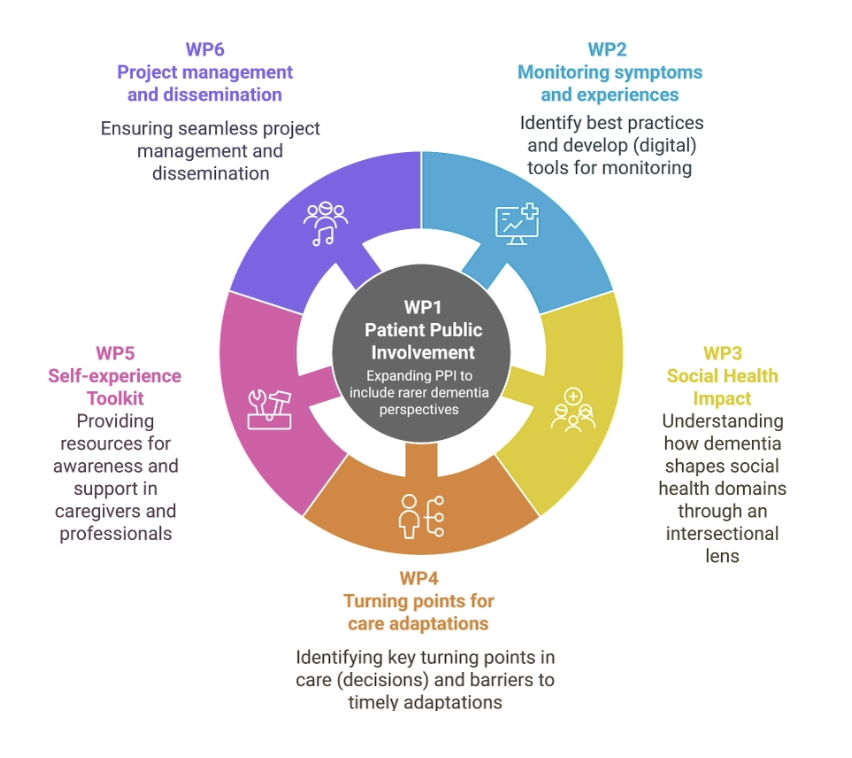
Structure of ENSURED
WP1: Patient Public Involvement
Alzheimer Europe, represented by Faye Forsyth (Public Involvement Officer), will lead Work Package (WP) 1: ‘Patient and Public Involvement’. This WP focusses on Public Involvement (PI), which is defined as “carrying out research and developing policies ‘with or by’ members of the public and patients rather than ‘to, about or for’ them as participants.” PI underpins all of the work in ENSURED; in this way the consortium will ensure that the experiences, priorities and values of people with lived experience are embedded and respected. Alzheimer Europe will support the project to undertake meaningful and respectful PI, ensuring best practice is adhered to.
WP2: Monitoring symptoms and experiences
Maastricht University, represented by Dr. Sara Laureen Bartels, will lead WP2: ‘Monitoring Symptoms and Experiences’. This WP focusses on understanding how symptoms, experiences and social health can be monitored over time in people living with frontotemporal dementia (FTD). The WP aims at identifying best practices for monitoring, assessing current implementation of monitoring in clinical and care settings. Through close collaboration with people living with FTD, informal caregivers and healthcare professions, WP2 will co-create and pilot a digital monitoring tool designed to support timely and person-centered care and to identify needs that may inform tailored support and interventions. With the guidance from WP1 and Public Involvement, WP2 ensures that the co-created tool reflects the real-world needs.
WP3: Social health impact
Despite growing recognition of social health as a key factor in dementia care, people with rarer dementias and their caregivers face unique social health challenges and care disparities that remain poorly understood and insufficiently addressed.
WP3, led by Prof. Martina Roes and Dr Seda Güney, aims to investigate through an intersectional lens (a) what are social health opportunities and challenges to address (un)met needs of individuals affected by rare dementias, (b) which health (care) disparities occur; and (c) how to overcome identified health (care) disparities.
Task 1: A scoping review to identify interventions addressing health disparities experienced by people with rare dementias. Task 2: A qualitative review of different policy papers (such as National Dementia Strategies) addressing rare dementias and/or health disparities and/or providing recommendations. Task 3: Interviews with people with rare dementias and relatives living in different European countries as well as professional stakeholders (e.g. National Alzheimer Organizations; politicians, health care staff). Task 4: Analyzing all results through an intersectional lens. Task 5: Defining recommendations. All results will be discussed with the EWGPWD and EDCWG organized by Alzheimer Europe (link WP1) as well as in local co-research groups (Germany and Turkey).
WP4: Turning points for care adaptations
People with rarer dementias (FTD, Lewy body dementia, vascular dementia) and their caregivers often face unpredictable care transitions, particularly in moderate to advanced disease stages – shifts from informal to formal care, changes in support needs, or acute health events. These transitions frequently trigger delayed, reactive responses rather than timely, proactive adaptations, leading to increased burden, fragmented care, and unmet needs.
WP4, led by Prof Dorota Szcześniak: ‘Social health impact’ investigates these critical turning points through a participatory and intersectional lens, combining semi-structured interviews with people with rarer dementias, informal caregivers, and healthcare professionals (75–100 interviews across Germany, Ireland, the Netherlands, Poland, and Turkey), care trajectory mapping, a comparative system-level analysis of policies and care structures across the five countries, and co-creation workshops with people with lived experience, caregivers, professionals, and policy stakeholders.
The WP aims to identify key turning points in care trajectories, uncover the medical, psychological, social, economic, and structural factors shaping decisions to adapt care, and map the barriers and facilitators to timely care adaptation across different healthcare systems. Outputs include a typology of turning points, a model of decision-making factors, a practical toolkit for caregivers and healthcare professionals, and final evidence-based recommendations for sustainable, person-centered care adaptation models – informing national dementia strategies and policy across Europe.
WP5: Self-experience toolkit
Dublin City University, represented by Dr Louise Hopper, will lead WP5: Self-experience Toolkit. WP5 aims to expand the INTENSE self-experience toolkit to support healthcare professionals and informal caregivers to gain deeper insight into the aetiology, symptoms, progression, and lived experience of rarer dementias, particularly in moderate to severe stages. Using an agile co-creation approach based on incremental, iterative development and ongoing evaluation and feedback, WP5 will build on existing INTENSE tools and integrate relevant insights and findings generated across ENSURED. Participatory co-creation workshops involving PPI contributors, stakeholders, researchers, and Social IT will inform the adaptation and development of new toolkit materials and pathways, including linguistic and cross-cultural tailoring. Polish and Turkish versions will be developed alongside the existing Dutch, English, German, and Italian versions, resulting in an updated toolkit available in six languages.